As I may have mentioned, I listened to Nelson Mandela’s autobiography A Long Walk to Freedom before coming on this trip. While Nelson has many great skills, story-teller seems not to have been one of them. I found it heavy on seemingly irrelevant details and light on how his imprisonment built the global anti-apartheid movement that finally brought an end to “the struggle.” Maybe that just isn’t a part of his story because he missed most of that and was cut off from so many events during his imprisonment.
The book did a great job of explaining about Mandela’s series of negotiations and meetings with De Klerk prior to his release and his aspirations for the newly born Republic of South Africa. There is a square in Cape Town, where there are statues of the four South African Nobel Prize winners, including Mandela and Bishop Tutu. Central to Mandela’s mission was to empower South Africans to match their potential with opportunity and justice, irrespective of race. Noble ideals indeed.
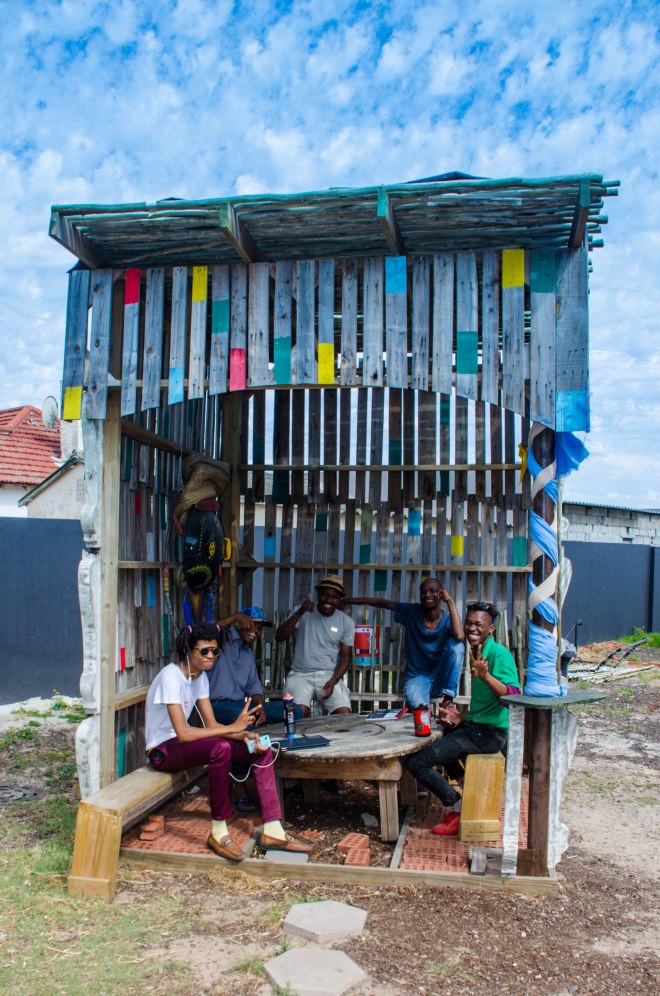
Twenty years on, many of the Struggle’s promises remain unfulfilled. Poverty, unemployment and macro/micro economic problems continue to plague South Africa and are particularly impacting black South Africans. As a part of the tour, we had lunch and tour in Langa township, one of the oldest black townships in Cape Town. Frankly, it was worse than some places I’ve seen and better than others.


You can see similar shantytowns in India, Haiti or Mississippi. Meanwhile, the government’s promises to build new housing and deliver better water, electricity and sewage infrastructure are slow to come to fruition. Blacks are no longer confined there by law, but for the vast majority, the township houses family and friends. Home is still home, no matter how bad it is. We toured an arts facility as well as some old dormitories where migrant male workers used to be housed, but now are crammed with families of 6-8 or more in a single room. We saw new construction of housing blocks, but the vast majority of homes were tin shacks crammed together along dirt path ways, with little or no electricity, running water, or basic infrastructure. Pretty grim.
Whenever I’m faced with such overwhelming poverty, I’m always left wondering how can I help or what should be doing. But persistent poverty remains a confounding problem and this government appears ill-equipped to meet a challenge of this scale. Which government is, frankly?
This gives me a chance for quick political rant. If any of us think we have it bad in the US, President Zuma of South Africa apparently sets new lows for corruption, cronyism, and ineptitude. And recently, he’s also accused of raping a woman he knew had HIV so he may be just plain dumb as well.
The ANC of today is a far cry from Nelson Mandela’s and the feeling is that he didn’t have sufficient time to train the next generation of leaders to mimic his selfless, results oriented leadership style. Everyone from cab drivers to colored and black guides mock Zuma’s government and despair for South Africa’s future. Decreasing business investment in the country coupled with significant social challenges would be daunting for the most capable and civic-minded leaders. And those are not the folks in charge today, sadly.
Because of my Southern roots, I’m hesitant to get onto my high horse about Apartheid policies or what should be done now about crime and poverty in the townships or the other malingering problems Safers (that what they call themselves) face. Our guides are hard pressed to name a single African country where a stable government or successful economy exists. Apparently, Botswana has high education and low corruption, thanks to the leadership of an African who married a white British woman (makes me want to see the recent movie about their marriage, A United Kingdom). Other than that, the island country of Mauritius, a former Portuguese colony, is faring well, largely because of its separation from the continent.
Africa is tough. In South Africa alone, people speak some two hundred and seventy languages. The same is true for each African country making it even more of a challenge to unify people toward common goals. So, so rich in natural resources, Africa battles huge population growth problems, health troubles, lack of education and weak or non-existent governance. The question for many here in South Africa is whether it will soon follow the downward spiral of its neighbors like Uganda and Zimbabwe, where Robert Mugabe’s thirty year rule has looted the countries natural resources, enriched his cronies, and decimated the country’s infrastructure and economy. Only time will tell which path South Africa will take.
I don’t begin to have solutions for such complex problems. I think the best any of us Westerners can do is look for people and organizations that are making a small difference in some people’s lives and invest there. REI does a good job of handling these issues carefully and treading lightly on the complexity without skipping the harder aspects of South African life all together. We got to visit a township, meet residents and ask questions. Perhaps she’ll gain her stride, but South Africa has some big work to do to deliver on the promise of freedom and opportunity for all.

