Be careful what you wish for.
Don’t tell the world (or at least the small slice of it that reads your blog) that you want to try new things, unless you are prepared to really try new things. When my neighbor invited me to his wife’s sold out performance of Icons of Sound: Hagia Sophia Reimagined, I must admit that it hadn’t been top of my to-do list for a Friday night. But he reminded me that I could hardly refuse given my new found commitment to trying to new things. Caught again.
The adventure almost defies description, but I will try. This performance was the result of the kind of resources, brainpower, creativity and imagination that resides within great academic institutions like Stanford (hats off to my neighbor who is a professor of medieval art there and co-creator of the event). It was a joint effort of the Art and Art History Department, the Center for Computer Research in Music and Acoustics, and the Theatre and Productions studies. In short, the effort combined the very best efforts of many, many experts in their fields joining together to try something — you guessed it–absolutely new. Apparently, these folks don’t require a blog to get them to try new things. They are constantly on the quest.
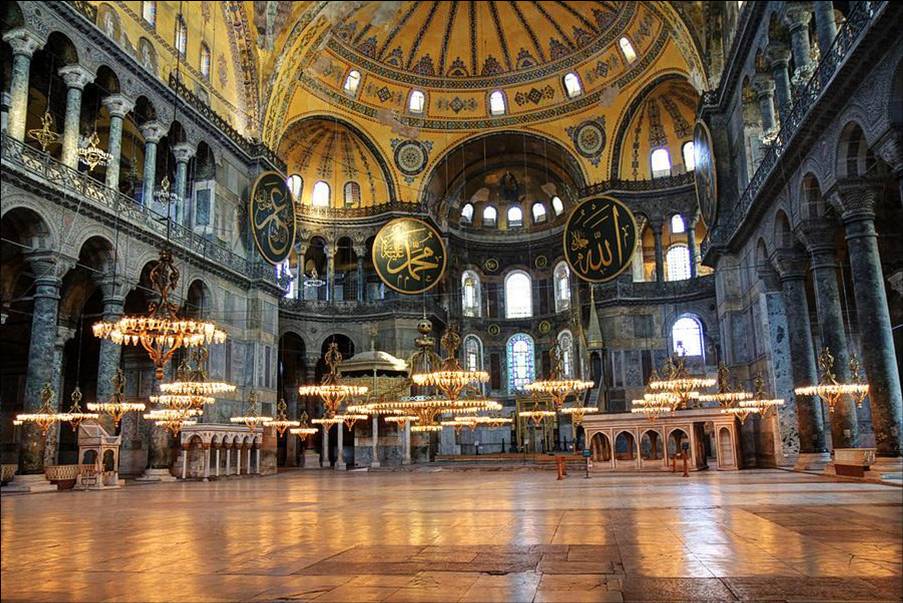
As we learned from several of the collaborators between performances, we were hearing new discovered Byzantine chants from the liturgy of Istanbul’s Hagia Sophia cathedral, often regarded as the world’s greatest example of Byzantine architecture. Performed by a Portland based vocal ensemble, Cappella Romana, the chanting was enhanced by hyper-accurate computer enabled acoustics which replicated the acoustics of the Hagia Sophia, which was the largest enclosed space in the world for over a thousand years. (On a side note, I’ll give you a flavor of the crowd that attends this type of highbrow academic and artistic endeavor. In the lobby, I heard someone dropping that fact (largest enclosed space for 1000 years) to his companion, only to be met with the question, “What replaced it?” Man, can’t you even dropped a factoid like that without being challenged for more? By the way, the Cathedral in Seville, Spain built in 1537 replaced Hagia Sophia as the largest building in the world. I looked it up.)
Anyway, the collaboration promised to transport the listener to Hagia Sophia, experiencing the sound, light, art, and music as though she were actually there. And transport us it did. As the chanting washed over us, it is impossible not to be soothed and uplifted by the calming rhythm. It lulled me into a meditative state, like a good chant can do but this was something different. It had the kind of deep resonance that you can feel deep in your belly. The normal echo footprint in the concert hall is about two seconds, but when the acoustic footprint of Hagia Sophia was enabled, it echoed for twelve seconds. It felt like we were a tiny part of a very massive musical expression. We also heard something that no one else can hear because they don’t even allow musical performances in Hagia Sophia anymore. I hope you can understand why I’m stumbling to find an adequate way to describe it.
It sounded like how you feel when you look up at the Sistine Chapel. Like there must be a God. Like this is what he can do. Like this is how God intended us to lift our voices and celebrate him. Like this is the very best of us, humans. And God is pleased.
 Boonedoggler